Hypnosis for Social Anxiety
Feel Comfortable Around People Again
If your mind races before a conversation and replays it for hours afterward, you already know social anxiety isn’t shyness and it isn’t a character flaw. It’s a learned fear response — and learned responses can be changed.
Hypnosis works with the part of your mind where that response was formed, gently helping it settle so being around people stops feeling like something you have to brace for.
Does This Sound Like You?
Social anxiety rarely looks the same from the outside as it feels on the inside. Most people who come to us are capable, thoughtful, and well-liked — and exhausted by how much energy it takes to appear at ease.
- You avoid conversations, calls, or events you’d actually like to attend
- You worry about saying the wrong thing and being judged for it
- You replay conversations for hours, sometimes days, afterward
- Your hands sweat, your face flushes, your voice tightens, your heart races
- You stay quiet in meetings even when you have something worth saying
- You’ve turned down opportunities — jobs, dates, promotions — to avoid the discomfort
- You feel isolated, and a little frustrated that this is still happening
If several of those landed, you’re in familiar company. Social anxiety is one of the most common concerns we work with, and one of the most responsive to change.
Why Social Anxiety Doesn’t Simply Go Away
Short answer: because avoiding a fear teaches your mind the fear was justified.
Every time you skip the event, stay silent in the meeting, or leave early, you feel relief. That relief is real — and your subconscious files it as proof that avoiding worked. The pattern gets a little stronger each time, which is why social anxiety often deepens with age rather than fading.
There’s a second layer. Your mind starts rehearsing the fear in advance. That’s anticipatory anxiety: the dread that builds for days before something that hasn’t happened yet. By the time you arrive, your body has already run the stressful event dozens of times.
None of this means something is wrong with you. It means a protective response learned its job well and never got the message that it isn’t needed anymore. Willpower doesn’t reach it, because the pattern isn’t stored in the thinking part of your mind. That’s the part hypnosis is designed to work with.
Many people also experience overlapping symptoms with general anxiety or panic attacks, and the same underlying approach applies.
How Hypnosis Helps Social Anxiety
Short answer: hypnosis helps you access the level of mind where the fear response was learned, so it can be updated rather than fought.
Hypnosis is a natural state of deep relaxation and focused attention. You stay awake, aware, and fully in control the whole time — most people describe it as the most relaxed they’ve felt in years. In that state, the mind becomes open to new information instead of defending the old pattern.
What that looks like in practice
- Interrupting the learned response. The automatic surge that fires when you walk into a room can be softened, so your body stops treating a conversation as a threat.
- Reducing anticipatory anxiety. Much of the suffering happens before the event. Hypnosis helps quiet the rehearsal loop so the days beforehand feel calmer.
- Building new emotional associations. Rather than only removing fear, we help your mind attach calm, curiosity, and ease to the situations that used to trigger dread.
- Strengthening genuine confidence. Not performance or bravado — the settled feeling of being okay as yourself, without monitoring every word.
- Quieting the post-event replay. The habit of reviewing and criticising conversations afterward tends to ease as the underlying anxiety settles.
Hypnosis is not a medical treatment and results vary from person to person. What we can say is that this pattern responds well to work at the subconscious level, and that most people notice something shifting earlier than they expected.
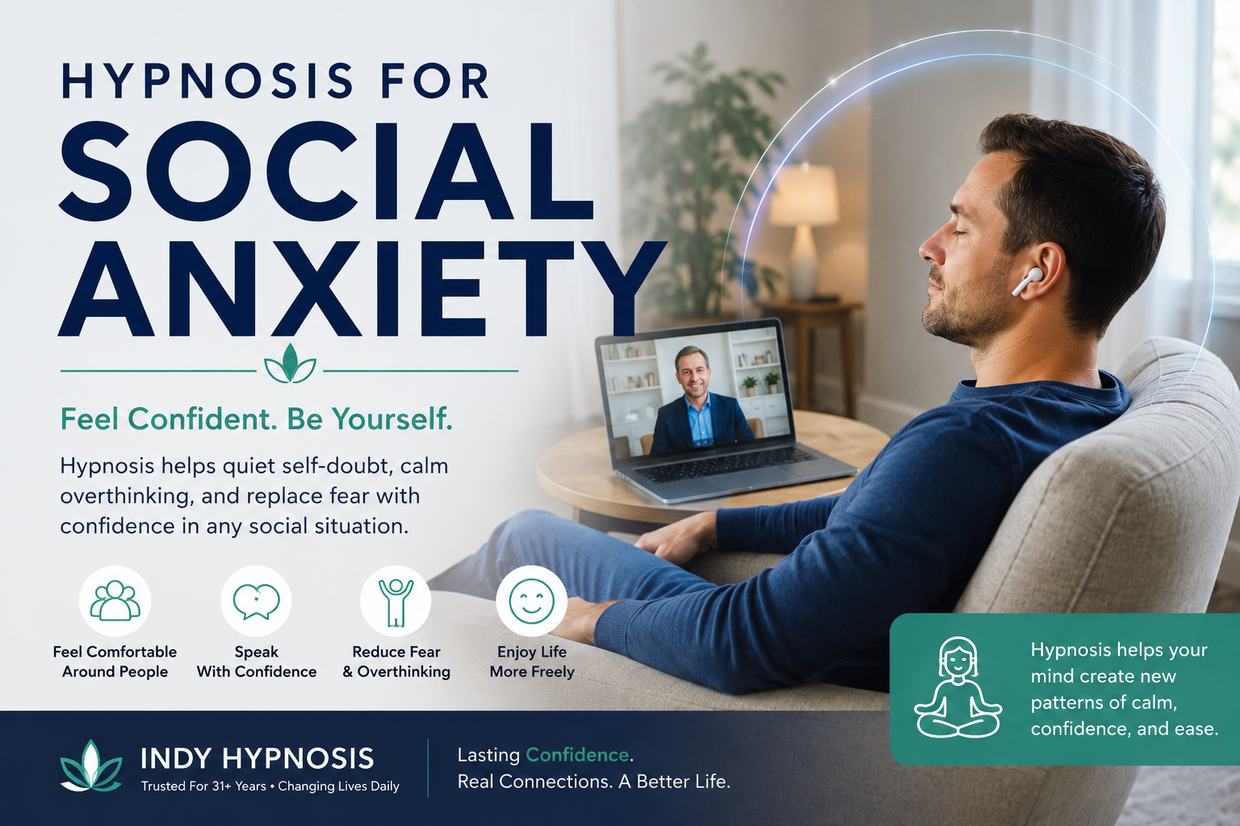
Many clients find virtual hypnosis for social anxiety just as relaxing and effective as meeting in person — and building confidence from the comfort of home is often an advantage rather than a compromise.
Imagine Living Without Social Anxiety
It’s worth picturing clearly, because your mind moves toward what it can imagine.
- You speak up in the meeting — and afterward you think about the work, not about how you sounded.
- You meet someone new and find yourself curious about them instead of scanning for signs you’re being judged.
- You walk into a networking room and it feels like a room, not an exam.
- You go on the date without three days of dread beforehand.
- You enjoy the family gathering instead of counting the minutes until you can leave.
- You eat in a restaurant, make the phone call, take the interview without your body sounding an alarm.
- You say yes to things — because the reason you were saying no has quietly stopped running.
That’s the real prize. Not becoming an extrovert, not performing confidence. Simply being comfortable being yourself around other people, and getting back all the energy you’ve been spending on managing it.
Why Choose Indy Hypnosis
Social anxiety is personal, and it deserves an approach built around you rather than a script.
31+ Years of Experience
Tim Shurr, MA has spent more than three decades helping people change patterns that felt permanent.
Thousands of Clients Helped
Social anxiety, fear of speaking, and confidence are among the concerns we see most often.
Secure Virtual Sessions
Work with us from wherever you feel most comfortable — often an advantage when social situations are the concern.
A Personalized Approach
Your fear pattern formed in your life, not in a textbook. Sessions are built around what’s actually driving yours.
Private Consultations
A calm, confidential conversation with no pressure and no sales pitch. You decide what happens next.
Read real client success stories, or meet Tim before you decide.
Frequently Asked Questions
Can hypnosis help social anxiety?
Yes, many people find it helpful. Social anxiety is a learned fear response, and hypnosis works at the level of mind where those responses are stored. Rather than managing symptoms in the moment, the goal is to settle the pattern that produces them. Results vary, and hypnosis is not a substitute for medical or psychological care.
What exactly is social anxiety?
Social anxiety is persistent fear of being watched, judged, or embarrassed in social or performance situations. It can show up as avoiding conversations, dreading events for days beforehand, physical symptoms like blushing or a racing heart, and replaying interactions afterward. It is different from shyness, which is a temperament rather than a fear response.
How many sessions are needed?
Most people work with us over a small number of sessions rather than months of weekly appointments. The exact number depends on how long the pattern has been running and what is driving it. We will give you an honest estimate during your free consultation rather than a package you have to commit to first.
Will I lose control during hypnosis?
No. You remain awake, aware, and in control throughout. You cannot be made to do or say anything you do not want to. Hypnosis is a do-with process, not a do-to process, and you will remember the session afterward.
Can hypnosis help with confidence generally?
Often, yes. Social anxiety and low confidence usually share the same root — a belief formed earlier about being judged, not being enough, or needing to stay safe. Work that settles one frequently improves the other.
Does hypnosis work online?
Yes. During a session you close your eyes and are guided verbally, so the experience is much the same in person or over video. For social anxiety specifically, many clients prefer starting from home, where they already feel comfortable.
What does a session actually feel like?
Most people describe it as deeply relaxing, similar to the state just before falling asleep but with clear awareness. You hear everything, you can speak, and you can open your eyes at any point. There is nothing strange or disorienting about it.
Will hypnosis make me a different person?
No. The aim is not to change your personality but to remove the fear response sitting on top of it. Quiet, thoughtful people stay quiet and thoughtful — they simply stop dreading the room.
Can hypnosis help with fear of public speaking?
Fear of speaking is one of the most common forms of social anxiety we work with. The same approach applies: quieting the anticipatory build-up and changing the association your mind holds with being watched.
I have tried therapy and self-help. Why would this be different?
Most approaches work with the conscious, thinking mind — understanding the fear, challenging the thought, practising exposure. Those can help. But insight alone often does not reach the pattern, because the pattern was not formed logically. Hypnosis works at the level where it was formed.
Is hypnosis safe?
For most people, yes. It is a natural state you already enter daily — absorbed in a book, driving a familiar route. That said, hypnosis is not appropriate for everyone, and we will tell you honestly during your consultation if we do not think it is the right fit for your situation.
Do I need a diagnosis to get help?
No. Many of our clients have never been diagnosed with anything. If social situations are costing you opportunities, relationships, or peace of mind, that is reason enough to have a conversation.
Can hypnosis help if I also have panic attacks?
Social anxiety and panic often travel together. If panic is part of your experience, that can be addressed alongside the social fear. You can read more on our page about hypnosis for panic attacks.
What if I cannot be hypnotized?
Almost everyone can enter the hypnotic state, because it is a natural ability rather than a special talent. The main thing that gets in the way is trying too hard. Being willing and reasonably comfortable is enough.
How much does this cost?
It depends on what you need, and we will tell you straight. Options range from free resources to private one-on-one programs. The consultation is free and there is no high-pressure sales pitch — we will lay out what fits your situation and budget, and you decide.
How soon might I notice a difference?
Many people notice something shifting within the first week or two — usually less dread beforehand rather than a dramatic change in the moment. Deeper, more consistent change typically builds over the following weeks. Everyone is different, and we will not promise you a timeline we cannot control.
What happens in the free consultation?
A relaxed, confidential conversation about what you have been dealing with, what you have already tried, and whether hypnotherapy is a sensible next step. No obligation, and no pressure. If it is not the right fit, we will tell you.
Related Resources
Struggling with anxiety more broadly?
Read our complete guide to hypnosis for anxiety and stress.
If social anxiety is part of a wider picture, these may help:
Hypnosis for anxiety and stress · Hypnosis for panic attacks · Hypnosis for driving anxiety · What is hypnosis? · Client success stories · Meet Tim Shurr · Book a free consultation
Ready to Feel Comfortable Being Yourself?
You don’t have to keep organising your life around avoiding people. Book a free, confidential consultation and tell us what has been happening. We’ll talk through what you’ve already tried, why it may not have worked, and whether hypnotherapy is a sensible next step for you.
If it isn’t the right fit, we’ll tell you that too. Either way you’ll leave the call understanding your situation better than when you got on it.