
Hypnosis for Driving Anxiety
Drive With Confidence. Enjoy Your Freedom Again.
If you plan your day around which roads you can handle, take the long way to avoid a highway, or have quietly stopped driving altogether, you are not being dramatic and you are not alone. Driving anxiety is a learned fear response — and learned responses can be changed.
Hypnosis works with the part of your mind that decided driving was dangerous, helping it settle so getting behind the wheel stops feeling like something you have to survive.
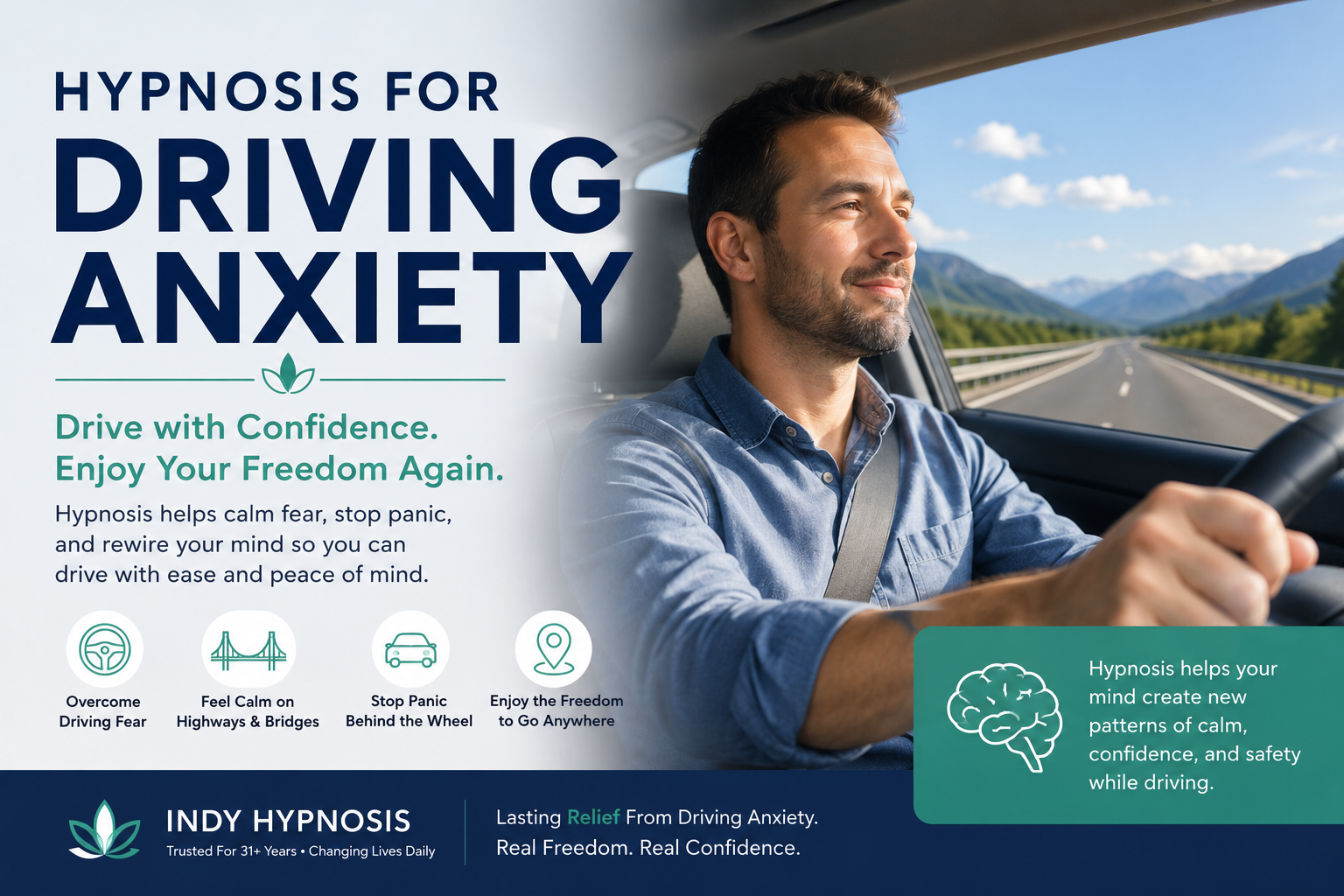
Thousands of people have gone from avoiding highways altogether to driving wherever they want. Virtual sessions mean you can start from home, at your own pace.
Does This Sound Like You?
Driving anxiety rarely announces itself. It usually starts small — one route you avoid — and then quietly reorganises your life around it.
- You avoid highways and interstates, even when they would save an hour
- You take longer routes so you can stay on familiar roads
- Bridges, overpasses, or tunnels make your chest tighten before you reach them
- You have pulled over — or wanted to — because panic came on while driving
- You will only drive if someone else is in the car with you
- You have turned down trips, vacations, or invitations because of the drive
- You depend on a spouse, adult child, or friend to take you places
- Sitting in stopped traffic makes you feel trapped
- You avoid driving at night, in rain, or anywhere unfamiliar
If you recognised yourself in several of those, this is one of the more common things we help with — and one of the most responsive to change.
Why Driving Anxiety Continues
Short answer: one frightening moment gets linked to driving, and every route you avoid afterward teaches your mind that the fear was right.
For many people it starts with a single event. A near miss. A panic attack on the interstate. A long drive where you suddenly felt lightheaded and far from home. Your mind did exactly what it is built to do — it tagged driving as dangerous so it could protect you next time.
Then the second loop begins. You avoid that stretch of road, and you feel relief. That relief is real, and your subconscious files it as evidence that avoiding worked. So the boundary grows. First the interstate, then bridges, then driving alone, then anywhere unfamiliar.
There is a third layer that catches people off guard: anticipatory anxiety. You start dreading the drive days beforehand. By the time you turn the key, your body has already rehearsed the worst version dozens of times.
None of this means something is wrong with you. It means a protective response learned its job well and never received the message that it is no longer needed. Willpower does not reach it, because the pattern was never stored in the thinking part of your mind. That is the level hypnosis works with.
Driving anxiety often overlaps with general anxiety and panic attacks, and the same underlying approach applies.
How Hypnosis May Help Driving Anxiety
Short answer: hypnosis helps you reach the level of mind where driving got linked with danger, so that association can be updated instead of fought.
Hypnosis is a natural state of deep relaxation and focused attention. You stay awake, aware, and fully in control the entire time. Most people describe it as the most relaxed they have felt in years. In that state, the mind becomes open to new information rather than defending the old pattern.
What That Looks Like In Practice
- Interrupting the learned response. The surge that fires as you approach the on-ramp can be softened, so your body stops treating a road as a threat.
- Reducing anticipatory anxiety. Much of the suffering happens before you leave the house. Hypnosis helps quiet the rehearsal loop so the hours beforehand feel calmer.
- Mental rehearsal. In a relaxed state you can practise the drive in your mind — merging, crossing the bridge, sitting in traffic — while staying calm. Your mind stores that version alongside the frightening one, and it begins to feel like the more familiar option.
- Building new associations. Rather than only removing fear, we help your mind attach calm, steadiness, and a sense of safety to the situations that used to trigger dread.
- Strengthening real confidence. Not bravado, and not white-knuckling it. The settled feeling of being capable behind the wheel.
Hypnosis is not a medical treatment and results vary from person to person. What we can say is that conditioned fear responses respond well to work at the subconscious level, and most people notice something shifting sooner than they expected.
If your anxiety also shows up around people rather than roads, our page on hypnosis for social anxiety may be a closer fit.
Imagine Driving With Confidence Again
It is worth picturing clearly, because your mind moves toward what it can rehearse.
- You drive to work on the route that actually makes sense, not the one that avoids the interstate.
- You cross the bridge and realise afterward that you were thinking about the radio.
- You run errands without mapping which parking lot has the easiest exit.
- You take the vacation that involves a six-hour drive, and you look forward to it.
- You drive your children or grandchildren to their games, their recitals, the beach.
- You say yes to a spontaneous trip without calculating the route first.
- You sit in stopped traffic and it is merely annoying, the way it is for everyone else.
- You get your independence back — no longer arranging your life around who can drive you.
That is the real prize. Not becoming a fearless driver. Simply getting in the car, going where you want, and feeling like yourself while you do it.
Why Choose Indy Hypnosis
Driving anxiety is personal. Yours formed in your life, on your roads — and it deserves an approach built around that.
31+ Years of Experience
Tim Shurr, MA has spent more than three decades helping people change patterns that felt permanent.
Thousands of Clients Helped
Fear of driving, highways, bridges, and panic behind the wheel are among the concerns we see most.
Nationwide Virtual Sessions
Secure online appointments from anywhere in the country — no drive required to get help with driving.
A Personalized Approach
Your fear has its own history and its own triggers. Sessions are built around what is actually driving yours.
Private Consultations
A calm, confidential conversation with no pressure and no sales pitch. You decide what happens next.
Read real client success stories, or meet Tim before you decide.
Frequently Asked Questions
Can hypnosis help driving anxiety?
Many people find it helpful. Driving anxiety is a conditioned fear response, and hypnosis works at the level of mind where those responses are stored. Rather than managing panic in the moment, the goal is to settle the pattern producing it. Results vary, and hypnosis is not a substitute for medical or psychological care.
What causes driving anxiety in the first place?
Often a single frightening experience — a near miss, a panic attack on the highway, or feeling unwell far from home. Your mind links driving with danger to protect you. Sometimes there is no clear event at all, and the fear builds gradually alongside general anxiety or a stressful period of life.
Can hypnosis help fear of highways and interstates?
Highway driving is one of the most common forms we work with. The fear usually centres on speed, merging, or not being able to stop and get off. Hypnosis addresses the association itself rather than teaching you to endure it.
Can hypnosis help fear of bridges?
Yes, bridges come up frequently. For some the fear is height, for others it is being unable to pull over. Both are learned responses, and both can be worked with in the same way.
Can hypnosis stop panic attacks while driving?
Panic while driving is frightening and often becomes self-reinforcing — you fear the panic more than the road. Hypnosis can help quiet the anticipatory build-up that precedes an attack and reduce the intensity of the response. Many clients report attacks becoming less frequent and less severe.
Will virtual hypnosis work for this?
Yes. During a session you close your eyes and are guided verbally, so the experience is much the same in person or over video. There is also a practical advantage: you do not have to drive somewhere to get help with driving.
How many sessions will I need?
Most people work with us over a small number of sessions rather than months of appointments. It depends on how long the pattern has been running and what is driving it. We will give you an honest estimate during your free consultation.
Will I lose control during hypnosis?
No. You remain awake, aware, and in control throughout. You cannot be made to do or say anything you do not want to. Hypnosis is a do-with process, not a do-to process, and you will remember the session afterward.
Do I have to drive during a session?
No. The work happens in your mind, in a relaxed state, before you go anywhere near a car. Many people find that when they next drive, the road simply feels different.
What is mental rehearsal and does it actually work?
Mental rehearsal means practising the drive in your imagination while deeply relaxed — merging onto the highway, crossing the bridge, sitting in traffic — and staying calm throughout. Your mind stores that calm version alongside the frightening one. Athletes and performers have used the same principle for decades.
I have not driven in months. Is it too late?
No. Length of avoidance does not mean the pattern is permanent — it usually means avoidance has had more time to reinforce it. We have worked with people who had not driven in years.
Can hypnosis help if I only get anxious with passengers in the car?
Yes. For some people the fear is about responsibility rather than the road itself — what would happen to the people relying on them. That is still a belief, and beliefs can be updated.
Is driving anxiety the same as agoraphobia?
Not the same, though they can overlap. Driving anxiety centres on the act of driving or particular roads. Agoraphobia is a broader fear of being somewhere escape feels difficult. If both are present, we will talk about that in your consultation.
What if I have tried therapy already?
Many of our clients have. Talk-based approaches work with the thinking mind, which can help you understand the fear without necessarily changing it. Hypnosis works at the level where the pattern was formed, which is why the experience is often different.
Is hypnosis safe?
For most people, yes. It is a natural state you already enter daily — absorbed in a book, or driving a familiar route on autopilot. That said, hypnosis is not right for everyone, and we will tell you honestly during your consultation if we do not think it fits your situation.
How much does this cost?
It depends on what you need, and we will tell you straight. Options range from free resources to private one-on-one programs. The consultation is free with no high-pressure sales pitch — we lay out what fits your situation and budget, and you decide.
How soon might I notice a difference?
Many people notice something shifting within the first week or two, usually less dread beforehand rather than a dramatic change mid-drive. Deeper change typically builds over following weeks. Everyone is different, and we will not promise a timeline we cannot control.
What happens in the free consultation?
A relaxed, confidential conversation about what has been happening, what you have already tried, and whether hypnotherapy is a sensible next step. No obligation. If it is not the right fit, we will say so.
Related Resources
Struggling with anxiety more broadly?
Read our complete guide to hypnosis for anxiety and stress.
If driving anxiety is part of a wider picture, these may help:
Hypnosis for anxiety and stress · Hypnosis for panic attacks · Hypnosis for social anxiety · What is hypnosis? · Client success stories · Meet Tim Shurr · Book a free consultation
Ready to Enjoy Driving Again?
You do not have to keep arranging your life around which roads you can manage. Book a free, confidential consultation and tell us what has been happening. We will talk through what you have already tried, why it may not have worked, and whether hypnotherapy is a sensible next step for you.
If it is not the right fit, we will tell you that too. Either way you will leave the call understanding your situation better than when you got on it.